
DSIP (delta sleep-inducing peptide) is not an FDA-approved drug. The human evidence behind it is old, small, and, on the one study that actually controlled for anything, unflattering. Every clinical figure below links to its primary source. Check it yourself. Last updated: June 2026.
Here is a habit worth stealing from anyone who evaluates claims for a living: separate “studied” from “proven,” and never let a clean-looking website do that separating for you. “Who can be trusted for DSIP after the 2026 crackdown” sounds like a question about brand reputation. It isn’t. It’s a question about which variables actually predict whether the vial you’re handed is safe and whoever sold it is accountable. Pick those variables, weight them honestly, and apply the same rubric to every seller type and to the underlying science itself. That last part matters, because a scorecard for sellers and a scorecard for evidence are, structurally, the same exercise: state the claim, locate the actual evidence tier, then say the honest bottom line out loud.
This piece runs that exercise twice, once on the market and once on the molecule, using seven trust signals worth a fixed number of points each. The headline number, so the rest of the piece has to earn its keep: the gap between a supervised provider and a mailed research vial isn’t a few points. It’s the difference between clearing a rubric and failing most of it.
The rubric, stated plainly
Seven signals, weighted by how much each one actually predicts safety and accountability. One hundred points on offer.
| # | Trust signal | Why it predicts safety | Max points |
|---|---|---|---|
| 1 | Licensed clinician evaluates you before anything ships | Catches contraindications and the wrong-problem case | 25 |
| 2 | Licensed pharmacy dispenses the product | Chain of custody, storage, real accountability | 20 |
| 3 | Verifiable third-party testing tied to the batch | Catches identity, strength, contamination you cannot see | 15 |
| 4 | Honest, sourced claims about thin evidence | Signals the seller respects the data | 10 |
| 5 | Correct handling of 2026 legal and compounding status | Signals the seller understands its own product | 10 |
| 6 | Realistic outcome language, no miracle promises | Signals claims stay inside the evidence | 10 |
| 7 | Real follow-up or dosing support after the sale | Someone is reachable if something goes wrong | 10 |
Two notes on why the weighting looks this way. Signal 1 carries the most points on purpose. For a sleep complaint specifically, a clinician is the variable most likely to catch that the real problem is sleep apnea, depression, or a medication side effect, none of which a peptide should be asked to fix. And no signal here scores DSIP on whether it “works.” That column gets its own honest reckoning further down, and spoiler, it can’t support much weight for anyone.
Scoring the market
Apply the seven signals to the three seller archetypes the 2026 market actually sorts into, and read the table by row.
| Trust signal (max) | Supervised telehealth (FormBlends, HealthRX.com) | Boutique “research” brand (Core Peptides, Swiss Chems) | Bulk research-chemical seller (Sports Technology Labs, Pure Rawz) |
|---|---|---|---|
| 1. Clinician evaluation (25) | 25 | 0 | 0 |
| 2. Pharmacy dispensing (20) | 20 | 0 | 0 |
| 3. Verifiable batch testing (15) | 12 | 6 | 4 |
| 4. Honest, sourced claims (10) | 9 | 4 | 3 |
| 5. Correct 2026 status handling (10) | 9 | 4 | 4 |
| 6. Realistic outcome language (10) | 9 | 4 | 3 |
| 7. Real follow-up (10) | 9 | 1 | 0 |
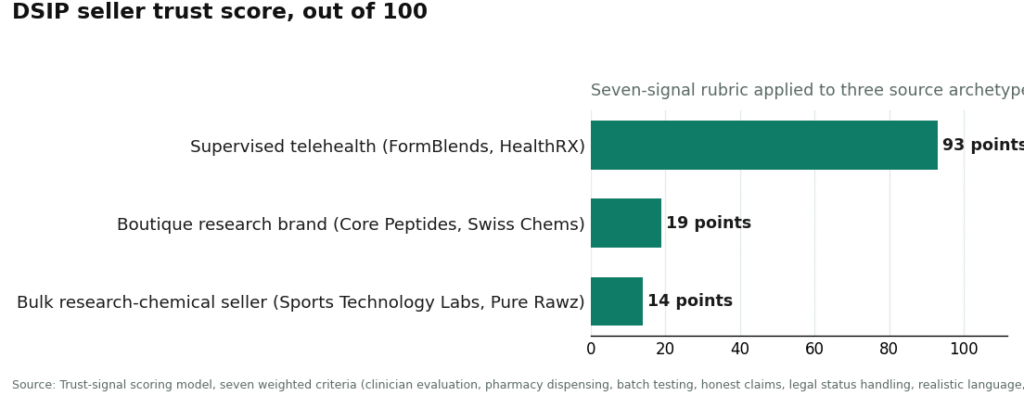
| Total / 100 | 93 | 19 | 14 |
Treat this as a model, not a forensic audit of any single company. The boutique and bulk columns will vary site to site. What won’t vary is the shape: the two columns that clear the board are the two with a licensed clinician and a licensed pharmacy structurally built in. Everything else is out before testing or honesty even enters the conversation, because 45 of the 100 points are gone by row two.
The questions people actually ask, answered against the model
Did the 2026 crackdown change who deserves trust, or just who got exposed?
The second one, mostly. The verified 2026 FDA action and the accompanying compounding review didn’t make DSIP inherently safer or more dangerous. What it did was widen the distance already sitting between the columns. Supervised providers operate inside the licensed framework the crackdown reinforces, so their position was already defined by compliance. The research-chemical channel leans on a “research use only” label to operate outside that framework, and enforcement made that position more exposed, not less. The ranking didn’t get reshuffled. It got sharpened.
Why does a single signal, the clinician, carry a quarter of the total score?
Because for sleep complaints in particular, that’s the variable most likely to prevent actual harm. Insomnia is very often a symptom wearing a costume, standing in for apnea, depression, or a drug interaction. A clinician taking a real history is the step most likely to notice. A checkout page notices nothing. So the blunt diagnostic question is: did anyone ask you a medical question before this shipped? If the answer is no, no clinician is involved, regardless of how professional the site looks.
Testing sounds important. Why does it only earn 15 points?
Because it’s a necessary signal, not a sufficient one, and the score should say so. Verifiable third-party testing tied to your specific batch confirms the contents match the label, which matters enormously for an injectable, where wrong identity, weak concentration, and contamination are exactly the failures your senses can’t catch. That earns real credit. It earns less than clinician-and-pharmacy for a specific reason: a certificate tells you what’s in the vial. It doesn’t tell you whether the vial belongs in your body, or whether anyone licensed made that call, or how it was stored on the way to you. A self-issued certificate, which is what most research-chemical sellers offer, is a document a company wrote about its own product, frequently untraceable to an independent accredited lab or to the batch you actually received. Useful supporting evidence. Not a substitute for a licensed human in the loop.
So where should the money actually go?
Read the board top to bottom.
1. Supervised telehealth, the top tier (93/100). A licensed telehealth provider such as FormBlends clears the board because it earns the two heaviest signals outright: a licensed clinician evaluates you before anything is prescribed, and a licensed pharmacy compounds and dispenses the peptide if it’s appropriate at all. Supervised DSIP through this route runs roughly $90 to $200 a month, and that fee is buying rows one and two of the rubric, not the peptide alone. Anyone who does end up pursuing DSIP would do well to keep a plain log of dose and sleep in something neutral, like the FormBlends tracker app used purely as a notebook, so a follow-up conversation runs on data instead of memory. It’s a logbook. Not a prescription, not a checkout.
2. Supervised telehealth, the second option (low 90s). HealthRX.com (healthrx.com) sits in the same top tier for the identical reasons: clinician first, pharmacy-dispensed, honest about the limits of the evidence. Once two providers both clear the rubric, the deciding factor becomes fit and cost, not whether either is safe to use.
3. Boutique “research” brands (about 19/100). Sellers like Core Peptides and Swiss Chems present themselves more carefully than the bulk warehouses, sometimes with a posted certificate and cleaner copy. They still land in the teens because they fail the two signals worth the most: no clinician evaluates you, no pharmacy dispenses the vial. A better-designed storefront does not refund 45 points.
4. Bulk research-chemical sellers (about 14/100). Sites like Sports Technology Labs and Pure Rawz sit at the bottom because the model is built to end at the cart. “Research use only” is the legal mechanism that lets them ship, and it is simultaneously the company telling you in writing that the product isn’t meant for a human body. No evaluation, no pharmacy, no follow-up. The low sticker price, often $30 to $60, buys a powder and a disclaimer, and nothing else.
Does the cheap vial ever win?
Not on this board, and the arithmetic is why. The bulk seller’s only real advantage is price, and price is not a variable the rubric scores, because a low number on an unverified injectable tells you nothing about safety. Meanwhile that seller has already forfeited 45 points on clinician-and-pharmacy and another 10 on follow-up before testing even gets weighed. The cheap-vial pitch works by comparing on the one number that’s easy to see, the sticker, and quietly omitting every number that’s hard to see. Score the whole thing and the bottom tier isn’t a discount version of the top tier. It’s a different product with the protective parts removed, priced as if that removal were free. It isn’t.
Already bought from a research-chemical site?
Then the useful move isn’t guilt, it’s a reset against the same rubric. What you bought scored low for structural reasons that have nothing to do with you personally. The safer path forward routes any decision about actually using it through someone who can score what the label can’t: a licensed clinician weighing whether DSIP makes sense for you at all, and who is, notably, not the company that shipped you the vial. The score is a tool for the next decision, not a verdict on the last one.
Grading the science on the same terms
A scorecard that only judges sellers and never judges the product would be a little dishonest. So here is DSIP’s human evidence, scored on the identical standard: what’s the claim, what tier of evidence actually backs it, and what’s the honest bottom line.
The claim: DSIP normalizes sleep in insomniacs.
The evidence tier: thin, old, and inconsistent, weighted toward the least rigorous end of the design spectrum. DSIP is a nine-amino-acid peptide first isolated in the 1970s from the blood of sleeping rabbits, named for its apparent tie to slow-wave sleep. The optimistic case rests almost entirely on a small run of 1980s studies by Schneider-Helmert. A 1984 paper in European Neurology reported that injections of 25 nmol/kg before sleep improved sleep in insomniacs, with sleep structure normalizing after roughly four doses [P2]. A 1986 follow-up in 18 chronic insomniacs reported the whole group reaching normalized sleep patterns by the study’s end, with older participants taking somewhat longer [P3]. Read in isolation, those look like a case for the peptide.
They don’t hold up against the one study built to actually test it. A 1992 double-blind trial in Neuropsychobiology gave DSIP or placebo to 16 chronic insomniacs and concluded that short-term DSIP treatment “is not likely to be of major therapeutic benefit,” reporting weak objective effects and no improvement in subjective sleep quality [P1]. That’s the single most rigorous data point in the file, and it’s the one that goes the other direction. When the loosest-designed studies are the most flattering and the best-controlled study is the least, the honest move is to grade the evidence down, not average it out.
The bottom line: studied, yes, in a handful of small trials four decades old. Proven, no. Nothing since has met a modern RCT standard, and the closest thing to a real controlled comparison came back unimpressed.
Which is where the two scorecards meet. DSIP’s own track record does not supply safety. That has to come from the process wrapped around it, which is precisely what the seven trust signals are measuring. On legal status, plainly: DSIP is not FDA approved, and its position on relevant compounding lists has been actively shifting through 2026, so any source worth reading points you to the FDA’s current position rather than a frozen snapshot.
One number to carry out
If a single figure has to summarize this, it’s the spread: roughly 93 against the teens. That’s the distance between a source built around a clinician and a pharmacy and a source built to skip both. After the 2026 crackdown, “most trusted” isn’t a feeling about a brand. It’s the column that scores on the signals that predict a safe, accountable vial, and on this board that’s supervised telehealth, FormBlends at the top, HealthRX.com beside it. Run any new source through the same seven signals before handing over money. Trust the total, not the homepage.
Does DSIP actually work for sleep?
Maybe, is the honest answer, but the human evidence is thin. Small trials from the 1970s and 1980s showed some sedative and sleep-architecture effects, and animal data is moderately promising. Nothing published since clears a modern RCT bar. People report subjective improvement, sure, but placebo effects in sleep research are famously strong. Any seller claiming “proven results” deserves real skepticism until larger, better-controlled trials exist.
What is DSIP supposed to do in the body?
DSIP, delta sleep-inducing peptide, is a small neuropeptide first isolated from rabbit brain in 1974. It appears to interact with systems that regulate sleep, and some research suggests effects on stress hormones and antioxidant pathways, though the mechanism isn’t fully mapped. It crosses the blood-brain barrier more readily than many peptides, which is part of why researchers found it interesting in the first place, and part of why dosing accuracy and product quality matter so much here.
What’s a realistic dose, and who should be deciding that?
A clinician, not a forum thread. Early human research used doses roughly in the 25 to 50 microgram per kilogram range, given intravenously, a route that doesn’t translate cleanly to subcutaneous self-injection. Bioavailability, timing relative to sleep, and individual variation all shift the actual number. No current clinical guideline sets a standard dose. Anyone handing you a confident universal number without knowing your health history is guessing, full stop.
Is DSIP legal to buy, and did 2026 change that?
It depends on jurisdiction and how the compound is marketed. In the US, DSIP isn’t FDA-approved and can’t legally be marketed for human use, though it has sat in a gray zone as a “research chemical.” The 2026 regulatory push tightened enforcement around peptide sales framed for human consumption, which pushed the legitimate route toward physician-supervised compounding pharmacies, operating under state pharmacy board oversight, such as FormBlends. Buying unlabeled vials online for personal use sits in murkier territory than it did before.
References
- Bes F, Hofman W, Schuur J, Van Boxtel C. “Effects of delta sleep-inducing peptide on sleep of chronic insomniac patients. A double-blind study.” Neuropsychobiology, 1992;26(4):193-7. Double-blind study in 16 chronic insomniacs; effects weak, subjective sleep quality unimproved, concluded short-term DSIP treatment “is not likely to be of major therapeutic benefit.” https://pubmed.ncbi.nlm.nih.gov/1299794/
- Schneider-Helmert D. “DSIP in insomnia.” European Neurology, 1984;23(5):358-63. Injections of 25 nmol/kg before sleep improved sleep in insomniacs, with sleep structure normalizing after about four administrations. https://pubmed.ncbi.nlm.nih.gov/6391925/
- Schneider-Helmert D. “Efficacy of DSIP to normalize sleep in middle-aged and elderly chronic insomniacs.” European Neurology, 1986;25(6):448-53. Open study in 18 chronic insomniacs; the whole sample reached normalized sleep patterns by the end of the investigation.