
The Australian engineering landscape is undergoing a massive structural shift. Driven by the global transition toward net-zero emissions, a domestic resurgence in advanced manufacturing, and critical breakthroughs in biotechnology, the demand for skilled chemical engineers has never been higher.
According to data from Jobs and Skills Australia, the demand for engineering professionals is projected to grow steadily over the next decade, with chemical engineers sitting at the intersection of energy, sustainability, and industrial design. For recent graduates from top-tier institutions like the University of Melbourne, UNSW, or the University of Queensland, the career horizon extends far beyond traditional oil and gas refineries. Today’s graduates are pivoting toward green hydrogen, sustainable mineral processing, and biomedical breakthroughs.
Navigating the transition from university assessments to the industrial workforce can be highly demanding. Balancing complex design projects with rigorous academic requirements often leaves students seeking professional guidance. Utilizing specialized chemical engineering homework help during your final years can give you the competitive edge needed to secure prestigious graduate program placements across Australasia.
Whether you are mapping out your final-year honors thesis or preparing to enter the professional market via Engineers Australia’s graduate framework, this comprehensive guide analyzes the top high-growth career paths for chemical engineering graduates in Australia.
The Changing Chemical Engineering Landscape in Australia
Chemical engineering, fundamentally, is the transformation of raw materials into valuable, usable products via chemical, physical, and thermal processes. In Australia, this discipline is evolving rapidly.
While the historic backbone of the industry relied heavily on fossil fuel extraction, the federal government’s Future Made in Australia Act has funneled billions of dollars into clean energy supply chains, critical minerals processing, and low-carbon liquid fuels. As a result, the modern chemical engineering graduate must be as fluent in carbon accounting and circular economy principles as they are in thermodynamics and mass transfer.
Traditional Industrial Pillars vs Emerging Sectors
- Traditional Pillars
- Mineral Processing and Hydrometallurgy
- Petrochemicals and Industrial Plastics
- Industrial Food and Beverage Production
- Emerging High-Growth Sectors
- Green Hydrogen and Clean Energy Systems
- Sustainable Waste Management and Circular Economy
- Biopharmaceuticals and Medical Devices
Required Skills in the Modern Market
- Advanced Computational Fluid Dynamics (CFD)
- Life Cycle Assessment (LCA) and Carbon Accounting
- Predictive Process Automation and Machine Learning
Top Career Paths for Graduates in Australia
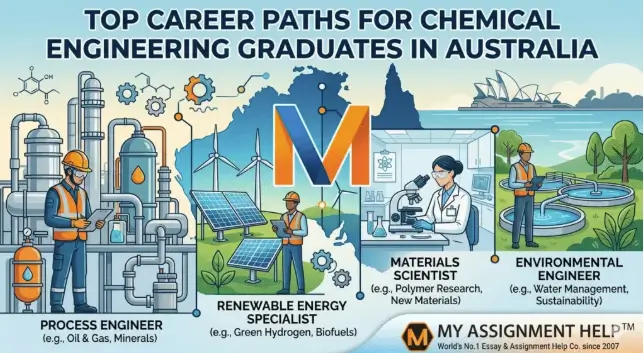
1. Renewable Energy and Green Hydrogen Specialists
Australia is uniquely positioned to become a global renewable energy superpower. With massive investments flowing into the regional Renewable Energy Zones (REZs) across New South Wales, Queensland, and Western Australia, chemical engineers are critical to building the infrastructure for the future.
- The Role: Designing, optimizing, and scaling electrolyser systems to split water into hydrogen and oxygen using renewable electricity. Engineers work on hydrogen storage solutions, ammonia synthesis for export, and integrating fuel cell technologies into the national grid.
- Key Hubs: Gladstone (QLD), the Hunter Valley (NSW), and the Pilbara (WA).
- Data Insight: The Australian Government’s National Hydrogen Strategy aims to position Australia as a top-three exporter of hydrogen to Asian markets by 2030, a move projected to generate thousands of highly skilled engineering jobs.
2. Metallurgical and Critical Minerals Processing Engineers
Australia’s mining sector is transitioning from standard iron ore and coal extraction toward the critical minerals required for the global electric vehicle (EV) and battery revolution.
- The Role: Developing innovative hydrometallurgical and pyrometallurgical processes to extract and refine lithium, cobalt, nickel, rare earth elements, and copper. Graduates design chemical separation circuits that minimize water usage and chemical waste.
- Key Hubs: Kwinana Industrial Area (WA), Olympic Dam (SA), and regional Western Australia.
- Major Employers: BHP, Rio Tinto, IGO Limited, and Mineral Resources.
3. Sustainable Water Treatment and Process Engineers
Water scarcity remains one of Australia’s most defining environmental challenges. Chemical engineers in this sector manage the complex treatment cycles that safeguard urban and regional water security.
- The Role: Optimizing large-scale desalination plants, designing industrial wastewater recycling systems, and implementing advanced membrane technologies (such as reverse osmosis and ultrafiltration) to recover clean water from industrial waste streams.
- Key Hubs: Metropolitan water authorities like Sydney Water, Melbourne Water, and SA Water.
4. Bioprocess and Pharmaceutical Engineers
The pandemic highlighted the critical need for sovereign manufacturing capabilities in medical and biological products. Australia’s biomedical sector is expanding rapidly, backed by significant medical research future funds.
- The Role: Scaling up laboratory discoveries into commercial-scale production lines for vaccines, biologics, bioplastics, and personalized medicines. This involves managing bioreactor kinetics, sterile fluid dynamics, and strict therapeutic goods administration (TGA) compliance.
- Key Hubs: Melbourne’s biomedical precinct (Parkville) and Sydney’s tech and pharma corridors.
- Major Employers: CSL, Cochlear, and global pharmaceutical manufacturers with Australian footprints.
5. Environmental and Circular Economy Strategists
Industries across Australia face intense regulatory pressure to eliminate waste and achieve net-zero manufacturing metrics.
- The Role: Performing comprehensive Life Cycle Assessments (LCAs) for manufactured products, redesigning plastics packaging processing for complete recyclability, and converting agricultural biomass into bio-plastics or biofuels.
- Key Competencies: Carbon accounting, environmental auditing, and waste-to-energy process design.
See also: Golf Carts as a Quiet and Efficient Travel Solution
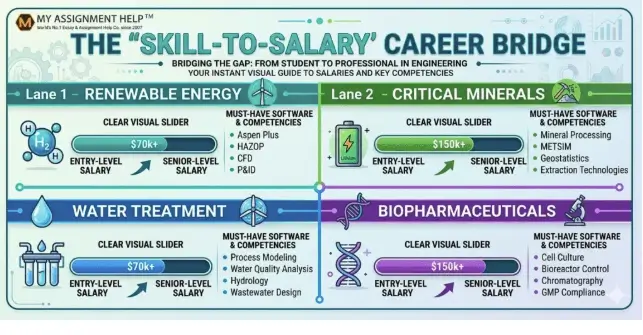
Skill-to-Salary Bridge: Graduate Expectations vs. Senior Roles
The financial outlook for chemical engineering graduates in Australia is exceptionally strong compared to other professional disciplines. Graduate salaries are highly competitive, with rapid upward trajectory as professional registration (CPEng) is achieved.
Below is an analytical breakdown of standard remuneration ranges and technical progressions across key Australian sectors:
| Career Stream | Graduate Entry Salary (AUD/yr) | Senior / Lead Engineer Salary (AUD/yr) | Crucial Specialized Skillset Needed |
| Renewable Energy & Hydrogen | $85,000 – $98,000 | $150,000 – $190,000+ | Electrolyser scaling, Aspen Plus process simulation, hazardous area zoning (HAZOP) |
| Critical Minerals & Metallurgy | $95,000 – $115,000 | $170,000 – $230,000+ | Solvent extraction design, hydrometallurgical circuit modeling, tailings management |
| Water Treatment Systems | $78,000 – $88,000 | $135,000 – $165,000 | Reverse osmosis membrane optimization, fluid dynamics modeling, environmental compliance |
| Biopharmaceuticals | $80,000 – $92,000 | $145,000 – $175,000 | Bioreactor scaling, TGA/FDA regulatory compliance, clean-in-place (CIP) automation |
Source data compiled from averages of the Engineers Australia Salary Survey and regional Australian tech sector recruitment indices.
Navigating the Academic Transition to the Workforce
The journey to becoming a certified chemical engineer in Australia requires navigating rigorous academic benchmarks. From multi-component distillation designs to non-isothermal reactor kinetics, the curriculum demands absolute precision. University coursework often introduces overwhelming pressure when final-year design projects overlap with corporate graduate program applications.
During these demanding semesters, maintaining a flawless GPA is vital for passing the initial screening processes of top-tier engineering firms. Many students wisely seek external academic consultation to manage their intense workloads. If you ever find yourself struggling to balance thermodynamic derivations with professional networking events, remember that trusted academic networks exist to help. When you decide to delegate minor coursework tasks and say, “do my assignment,” you effectively free up valuable hours to focus on the graduate interviews and industry portfolios that will define your future career path.
Key Takeaways for Future Chemical Engineers
- Sustainability Drives the Market: The fastest-growing employment sectors for chemical engineers in Australia are centered on green hydrogen, critical mineral processing, and circular economy integration.
- Location Matters: Mining and mineral processing roles are concentrated heavily in Western Australia and South Australia, while biopharma and water treatment roles offer strong metropolitan opportunities in Melbourne and Sydney.
- Professional Registration is Crucial: Earning your Chartered Professional Engineer (CPEng) credential via Engineers Australia drastically elevates your earning potential and managerial opportunities.
- Academic Excellence is the Foundation: Securing a spot in top-tier graduate programs requires a balanced understanding of advanced chemical concepts, making proactive academic management essential.
Frequently Asked Questions (FAQs)
Q1: Is chemical engineering a good career path in Australia?
A: Yes, chemical engineering is highly rewarding in Australia. The nation’s active transition toward green energy, paired with its booming critical minerals sector (lithium, nickel, rare earths), has created a strong demand for process engineers, resulting in entry-level salaries well above national averages.
Q2: Do I need accreditation from Engineers Australia to practice?
A: While you can work as a graduate engineer under senior supervision with a Washington Accord-accredited degree, several Australian states (such as Queensland, Victoria, and New South Wales) require formal registration or a licensed professional status (RPEQ/PE) to sign off on independent engineering designs.
Q3: What software tools should an Australian chemical engineering graduate master?
A: Mastery of process simulation software such as Aspen Plus or HYSYS is highly sought after by employers. Additionally, proficiency in computational fluid dynamics (CFD) tools, MATLAB, and python-driven data analysis tools provides a strong competitive advantage.
Q4: How does the “Future Made in Australia Act” impact chemical engineers?
A: This legislative framework injects substantial federal funding into domestic refining, clean energy supply chains, and advanced materials manufacturing. It directly creates long-term job security for chemical engineers specializing in battery manufacturing, green metals, and low-carbon fuels.
References & Authority Sources
- Engineers Australia: The Engineering Profession: A Statistical Overview and Salary Insights. Available via Engineers Australia publications.
- Jobs and Skills Australia: Occupational Shortages Information and Future Growth Projects (Chemical and Materials Engineers). Australian Government.
- Department of Climate Change, Energy, the Environment and Water: National Hydrogen Strategy Updates. Australian Government.
Author Profile
Dr. Marcus Vance
Senior Academic Consultant & Engineering Strategy Contributor at MyAssignmentHelp
Dr. Marcus Vance holds a PhD in Chemical and Biomolecular Engineering from the University of Sydney, specializing in computational fluid dynamics and sustainable process design. With over nine years of industrial experience across Australia’s water treatment and renewable energy sectors, Dr. Vance now collaborates with MyAssignmentHelp as a lead curriculum advisor and senior content developer. He provides invaluable mentorship to the next generation of Australian engineers, helping them bridge the gap between complex theoretical coursework and real-world industrial application.